


Mike's NIU runs on electricity from the garden
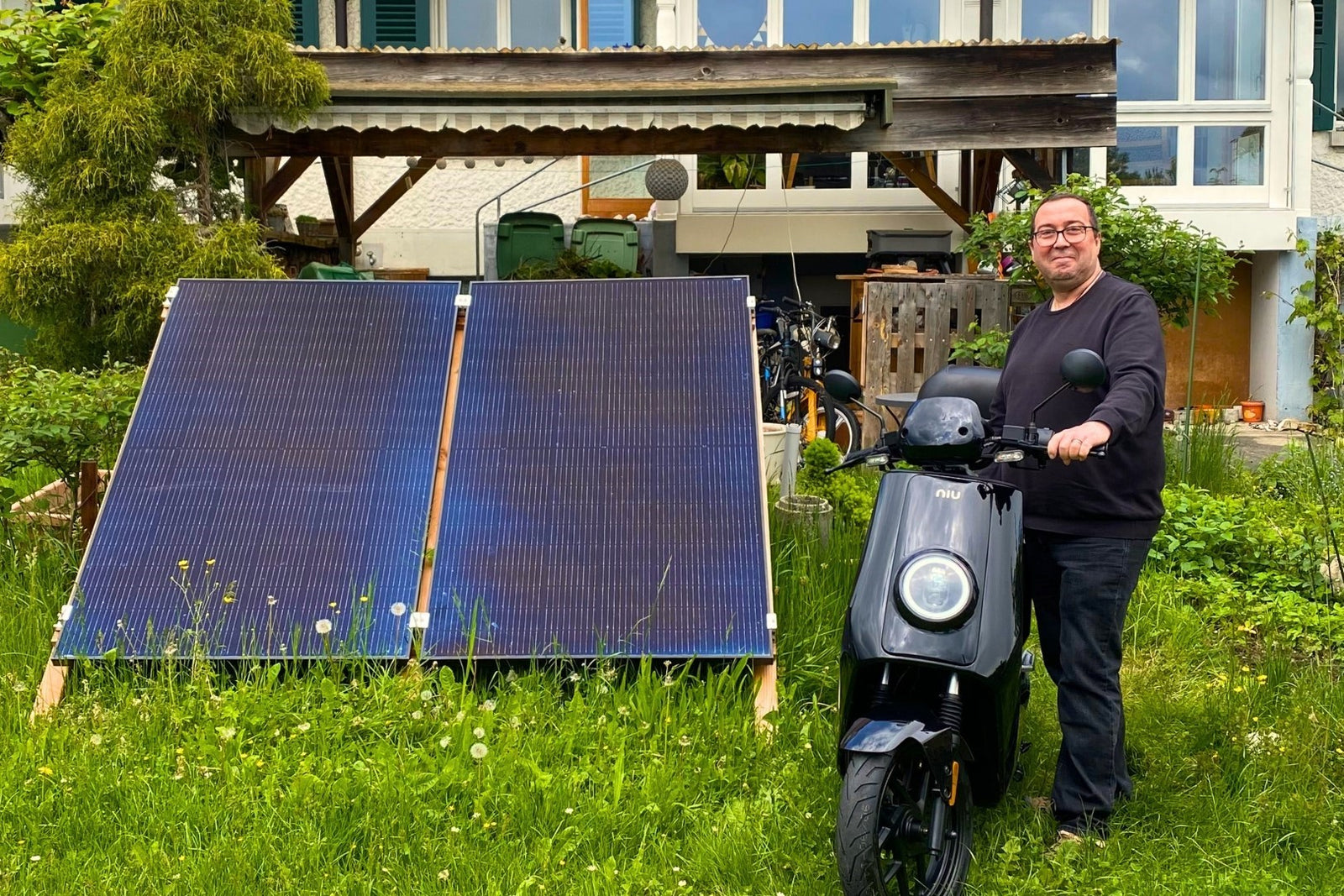
Anyone wanting to generate their own electricity can install a photovoltaic system with a capacity of up to 600 watts without a permit. One such "balcony power plant" stands in a quiet neighborhood in Burgdorf. Since the apartment lacks a balcony, it’s simply located in the garden. It looks quite small. And yet, it provides enough electricity annually to power Mike's NIU e-scooter for 20,000 km. Theoretically.
Circumnavigating half the globe on an electric scooter isn't really Mike's cup of tea. He uses his NIU NQi GTS 80 km/h on a subscription basis as a local transport and commuter vehicle between Burgdorf and Bern. He covers about 4,000 km a year. The NIU scooter has only marginally influenced his decision to generate his own electricity.
Motivation: more fun and curiosity than high profitability
IT specialist Mike is one of those people who likes to try things out. "I'm interested in all kinds of future-oriented, sustainable technologies, and tinkering with them is practically a hobby of mine," comments the man, who is also currently programming a self-driving model car... The mini-PV system is therefore not intended as a "profit," but rather as a learning, experiential, and fun project. But in fact, his small solar project is also paying off financially.
Amortized after 5 years and a contribution to clean electricity
Mike has invested around 900 Swiss francs in his small power plant. On good days, the 600-watt system generates over 4 kilowatt-hours of electricity. That's more than 800 kWh per year. Electricity he would otherwise have to buy for 30 centimes per kWh. When his panels are producing energy, it's used directly in the household (cost savings: 30 centimes per kWh) or, if there's a surplus, fed into the grid (revenue: 15 centimes per kWh). So, if Mike charges his NIU during the day, he benefits to the fullest because the self-generated electricity is used 100%.
After about 5 years, the system will have paid for itself and will then generate only net profit. More importantly, the mini solar system ensures that a significant portion of a household's electricity consumption is produced sustainably, without wasting fossil fuels and without the risks and waste disposal problems associated with nuclear power.
 A look at the «myStrom» app: Although May was not a month with good weather, the «garden power plant» supplied the household with a remarkable 90 kWh of energy.
What do you need to build one yourself?
According to Mike, it's all quite straightforward: "No operating permit is required; registration with the local energy supplier is sufficient. Tenants, however, must obtain the landlord's consent. Otherwise, the project involves a few components and, of course, a few hours of time." Here's what Mike specifically installed:
- two coupled solar panels with a nominal power of 325 watts each
- an inverter that converts to 230 volts and also regulates the upper limit of 600 watts.
- a small «myStrom» plug-and-play device that provides him with information via app about the generated and fed-in electricity
- a new “smart meter”, which is provided by the energy company upon registration.
- a wooden frame that he built himself to achieve the best possible angle in the garden (and at the same time protect plants that don't like direct rain)
Why not install a photovoltaic system on the roof?
Mike's decision to opt for a mini-PV system at his home is primarily due to practical reasons: "On the one hand, we are tenants and a roof installation would not be easily possible; on the other hand, the entire residential area is a listed building and the roof structure makes the implementation of a solar system rather difficult."
And so the project is probably finished for now. On to the next one!